
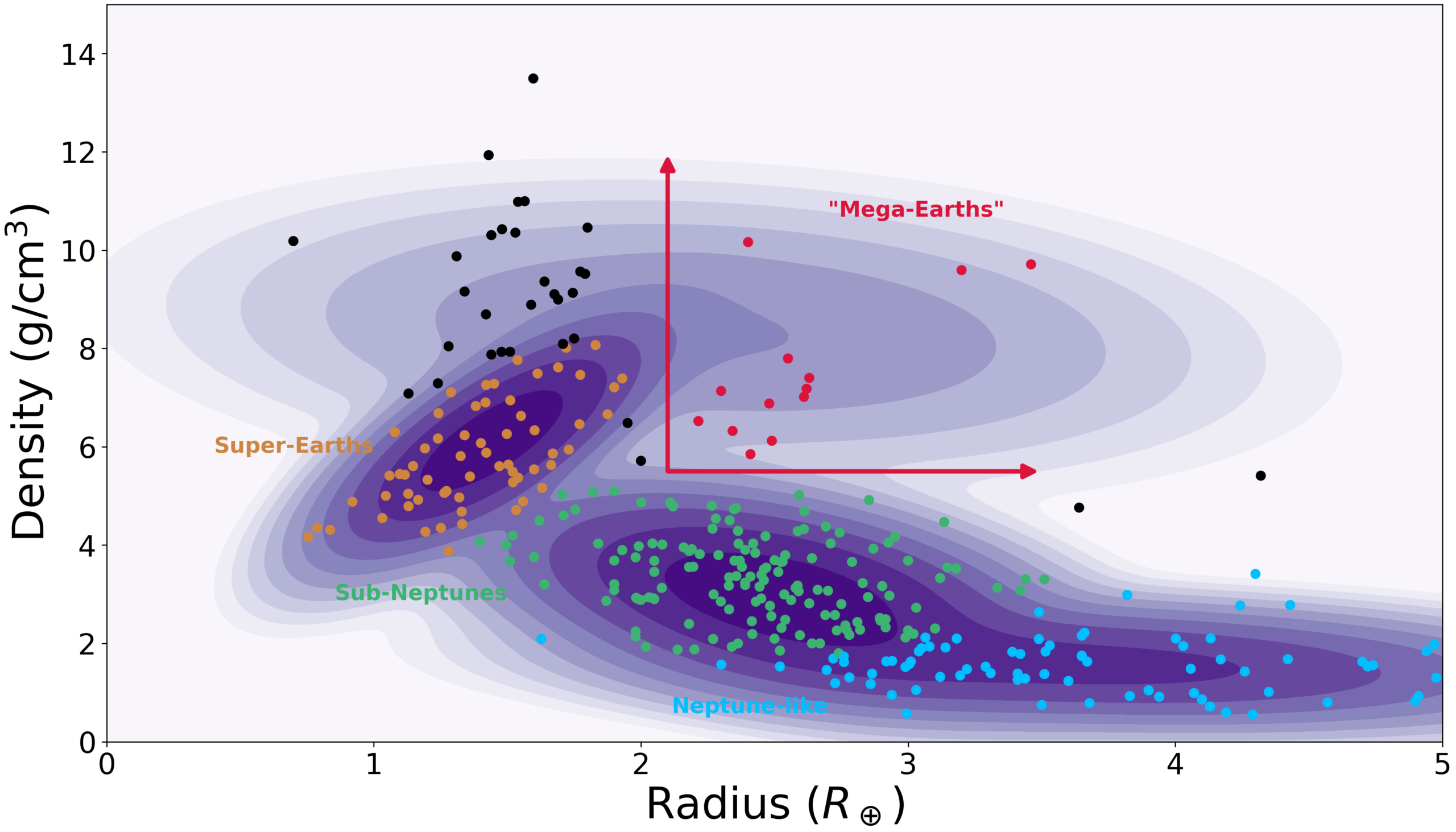
Mega-Earths are a fascinating topic in astronomy, raising questions about their existence and formation. Recent studies suggest that stellar activity may provide explanations for these oversized rocky worlds.
What are Mega-Earths?
Mega-Earths are a class of exoplanets that are significantly larger than Earth, often characterized by a mass greater than 2 times that of our planet. These celestial bodies fall into a category that has intrigued astronomers and planetary scientists alike, as they challenge our understanding of planet formation and composition.
Despite their name, the existence of mega-Earths is still debated within the scientific community. Some researchers argue that what we perceive as mega-Earths may actually be the result of stellar activity, such as fluctuations in brightness or other external factors that can create misleading signals when observing distant worlds.
Characteristics of mega-Earths include:
- Increased gravity compared to Earth
- Potentially thicker atmospheres
- Possibility of diverse geological features
As telescopes improve and our observational capabilities expand, the quest to confirm the existence and nature of mega-Earths continues, promising to deepen our understanding of planetary systems beyond our own.
The Role of Stellar Activity
The exploration of mega-Earths has sparked significant debate among astronomers, particularly regarding the impact of stellar activity on their detection. Understanding the role of stellar phenomena is crucial in interpreting data related to these oversized rocky worlds.
Recent studies suggest that fluctuations in stellar brightness, often caused by magnetic activity, can mimic the signals associated with planetary transits. This phenomenon raises questions about the reliability of current observations of mega-Earths.
Key factors influencing this confusion include:
- Starspots: Similar to sunspots, they can dim the light from a star, leading to misleading signals.
- Flare Activity: Intense bursts of energy can alter a star’s luminosity, complicating the identification of orbiting planets.
- Variability: Some stars exhibit intrinsic brightness variations that may overlap with planetary signals.
These complexities suggest that while mega-Earths are an exciting area of research, our understanding may be clouded by stellar activity, necessitating further investigation to confirm their existence.
Implications for Planetary Science
The discovery of mega-Earths has significant implications for our understanding of planetary formation and evolution. These oversized rocky worlds challenge traditional models that categorize planets based solely on size and mass. As researchers delve deeper into the characteristics of these celestial bodies, they are forced to reconsider the parameters that define a planet’s classification.
One major implication is the potential for re-evaluating the conditions necessary for life. If mega-Earths exist in diverse environments, it may broaden the scope of where we search for habitable worlds. Additionally, the study of these planets can shed light on the geological processes that shape them, which are likely influenced by their proximity to their host stars.
Furthermore, understanding mega-Earths could enhance our knowledge of stellar activity. The interaction between a planet and its star can lead to complex atmospheric phenomena. Researchers must investigate whether these oversized planets are indeed distinct entities or if they are simply a product of stellar activity, which would reshape our perspective on planetary systems.
Future Research Directions
As researchers continue to investigate the nature of mega-Earths, several future research directions are becoming increasingly important. Understanding the formation and characteristics of these oversized rocky worlds requires a multi-faceted approach.
- Advanced Observational Techniques: Utilizing next-generation telescopes will allow scientists to gather more accurate data on the atmospheres and compositions of mega-Earths. This could help distinguish between genuine planetary features and artifacts caused by stellar activity.
- Comparative Planetology: Studying similar exoplanets and their environments may provide insights into the formation processes of mega-Earths. Insights from our own solar system could also play a crucial role in this comparative analysis.
- Stellar Activity Models: Developing more sophisticated models of stellar activity will be essential. By improving our understanding of how these activities influence observations, researchers can refine their methods for detecting true planetary characteristics.
- Simulations and Theoretical Models: Creating simulations to predict the dynamics of mega-Earths and their interactions with stellar environments will enhance our understanding of their potential diversity.
These research directions will be vital in clarifying whether mega-Earths are indeed a distinct category of planets or merely a product of stellar phenomena.
By Maxwell A. Kroft et al. (2026) via Openverse
Where this came from
Related reading
Is the iPhone Duo launch the best tech event of 2026? · Honor 700 series: Best models with proven features · iPhone Air 2 Leak: Is This the Best Surprise from Apple?





Leave a Reply